Guided Troubleshooting: Can you find the interface modules?
Can you find the interface modules (e.g. an ES592 or an ES910) used for connecting the devices listed in the message?
 How to find out whether interface modules can be found
The message window informing you about not connected hardware only lists items on device level, but not the interface modules used.
Example: If an ETK is connected to the INCA PC via an ES592 interface module, the dialog will only mention that the ETK could not be found; whether the ES592 could be found or not is not indicated here.
To find out whether the interface module can be found:
Is more than one device connected to that interface module (e.g. you are using an ES592 with both XCP-on-CAN and ETK)?
- If one of these devices can be found and the other can't: the interface module is available; the problem relates only to the device itself. Follow the Yes-link above.
- If none of the connected devices can be found: continue with the steps below.
Use one of the following methods to find out whether the interface module can be found:
Via INCA:
Do a search for hardware (e.g. by opening the Hardware Configuration Editor and clicking in the toolbar).
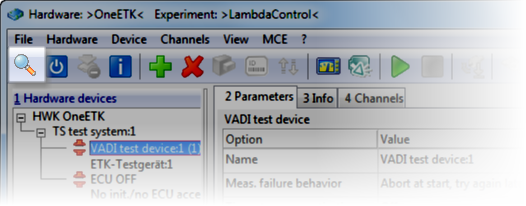
All connected hardware found by INCA is inserted in the hardware configuration tree (if non-ambiguous), or listed in a mapping dialog.
Note
When connecting to the hardware for the first time, the serial number of the modules is read from the devices and saved in the hardware configuration. The serial numbers will be used for mapping the modules found by INCA with the hardware configuration displayed in the tree and saved with the workspace.
If you connect to a hardware network with the same logical setup, but physically different modules, the hardware will not be mapped automatically; you will have to replace the systems or set up a new workspace in INCA. If you want to avoid this, you can remove the serial numbers in the parameter tables of the Hardware Configuration Editor and then initialize the devices to assign them to the hardware in the tree view.
Via the IP Manager (only for Ethernet hardware):
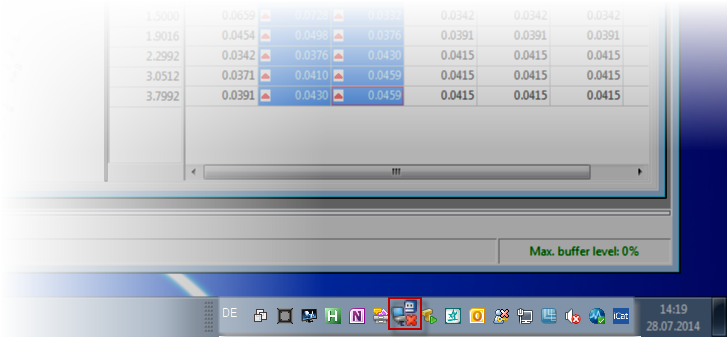
Look for the IP Manager icon in the Windows taskbar.
 Screenshot: Windows 10 taskbar with IP Manager icon
The Windows taskbar is located at the bottom of the monitor (right justified, next to the system clock):
Note
The IP Manager icon may not be visible in the Windows taskbar, even if INCA is started and the hardware initialized. If you don't see the IP Manager icon, reconfigure your taskbar to make the IP Manager icon visible.
Details for Windows 10Click the arrow on the Windows taskbar to open a pop-up list of the icons which are currently set to hidden mode.
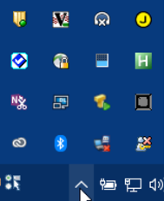 .
.Drag the IP Manager icon
 onto the taskbar.
The IP Manager icon is now shown in the Windows taskbar.
Right-click on the IP Manager icon and select 'Ethernet system configuration' from the context menu.
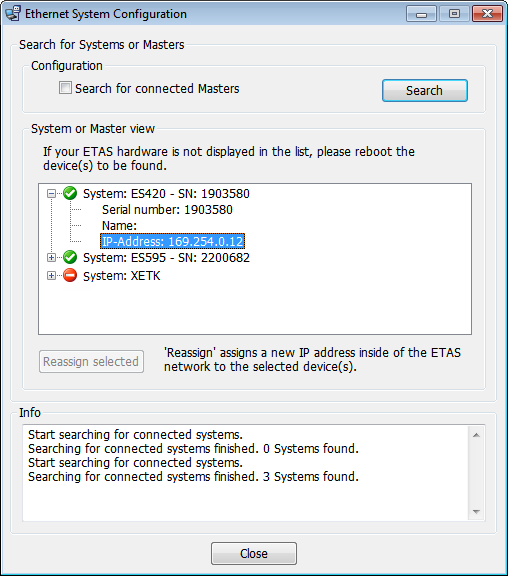
A dialog opens. The field 'System or Master view' displays a tree view of all Ethernet hardware systems that were found by the IP Manager.
The icons in front of the system name show whether communication is possible or not.
If a system is preceded by the icon
 , the system can be found, but communication is not possible, e.g. because the IP address of that system is located outside of the IP address range for ETAS hardware.
If the list is empty, the IP Manager could not find any Ethernet measurement and calibration hardware.