Defining a Calculated Signal (Free Calculation Formula)
In the Define Calculated Signals dialog box, you have activated the Standard field.
To define a calculated signal:
Enter a name and a data type for the calculated signal.
Note
If you define calculated signals for a Drive Recorder output, select always the data type bool. A Drive Recorder processes only boolean signals.
If you define a trigger condition, the trigger data type is set.
If you define calculated signals for the use on a DriveRecorder, select only bool as data type.
- Optionally, you can enter a unit of measurement and a brief description of the calculated signal.
Assemble the formula for the calculated signal in the Calculation Rule by linking the elements with operations and functions.
Note
If you use the "==" operator, an exact comparison of the value including all decimal places is executed. To conduct an approximate comparison, use the "abs" function in combination with the requested accuracy. For example, abs([engine speed] - [1000]) < [10] returns results for the value range from 990 to 1010 rpm.
You can use the following input:
 Measured Signal
Opens the Variable Selection dialog box in which you select a measured signal for the definition of the calculated signal.
Calculated SignalOpens the Available Calculated Signals dialog box in which you select an already calculated signal as input value for the definition of the newly calculated signal.
Measure TimeInserts a variable for the relative calculation period. This variable returns the relative time in seconds between the start of measurement and the calculation of the signal. The measurement time can be used for standardizing time-dependent values.
ConstantsOpens the Available Constants dialog box in which you select a predefined constant for the definition of the calculated signal.
Define a calculation rate:
Fixed rate [ms] radio buttonSpecifies the duration of the calculation period.
Same as signal radio buttonSpecifies the signal used as calculation rate.
Select All from the list to use a calculation rate that results from the combination of all rasters of all input signals.
or
- From the list, select the entry for the input signal whose calculation rate you want to use.
Define whether a text conversion table is to be stored and, if so, which one:
None radio buttonDefines that no conversion is used.
Verbal radio buttonDefines that a verbal description is stored.
- Click Define.
In the Conversion Table dialog box, enter a value and a text.
Click Check to check the syntax of the formula.
The newly defined calculated signal is checked and, if the check is successful, it is accepted. If the formula contains any errors, the check result is displayed.
- Click OK.
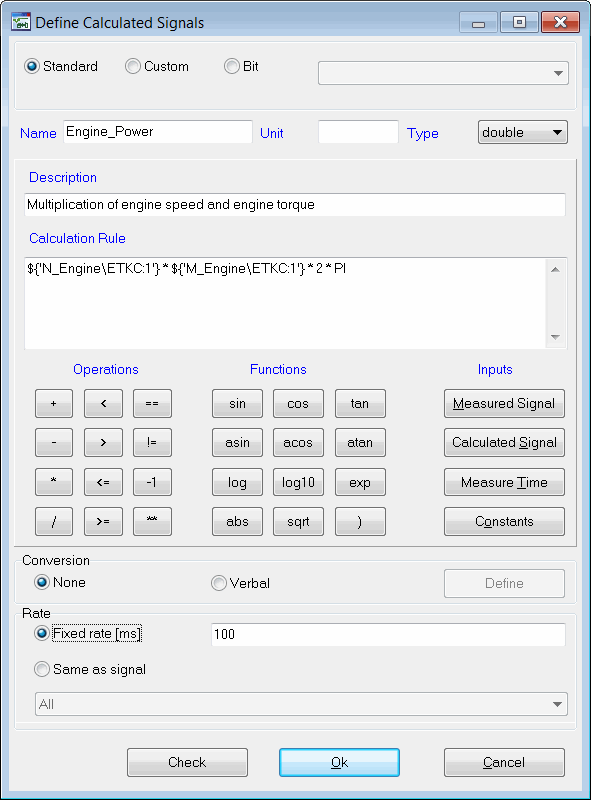
Calculating Engine Power
The engine output P (in Watt) can not be determined directly. However, physically it is the product of the engine speed N (in rotations per minute) and the torque M (in Newton meter).
Therefore the engine power can be calculated according to the following free calculation formula:

This formula is defined in the DefineCalculated Signals dialog box in the following way:
See also