Evaluation Behaviors and Tolerance Types
For each threshold, you can define the evaluation behavior and / or the tolerance type. If you combine both, it has an impact on the evaluation.
Evaluation Behaviors
-
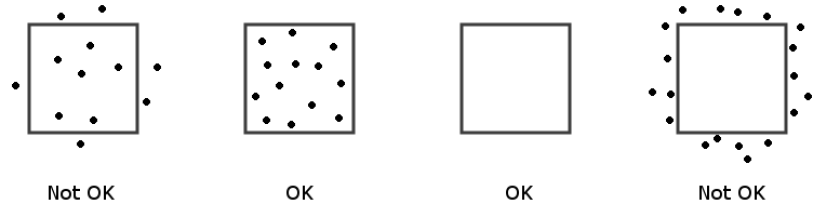
all:
As long as at least one point is outside the feasible range, the threshold is violated.
-
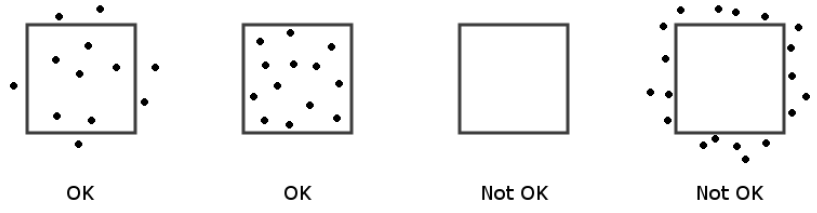
any:
As long as at least one point is in the feasible range, the threshold is not violated.
Tolerance Types
You can set the tolerance for the evaluation of traffic lights. In this case, the traffic lights change if the tolerance condition also applies.
|
Note |
|
The MinMax table does not support any tolerance types. |
The following tolerance types are available:
-
percent:
Tolerance type that defines the minimum or maximum percentage of the points that must or may lie inside or outside the feasible range without violating the thresholds.
-
time:
Tolerance type that defines the maximum time in seconds, for which the time series can leave the feasible range continuously, and the thresholds would still be considered as not violated.
-
count:
Tolerance type that defines how many points are allowed to lie inside or outside the feasible range and the thresholds would still be considered as not violated. This evaluation behavior corresponds to percent tolerance but uses the absolute instead of relative point numbers.
|
Note |
|
For percent and time, the value has to be in quotation marks. For count, it is not allowed to use quotation marks for the value. |
Combinations of Evaluation Behaviors and Tolerance Types
The ranges are based on the definition as given in Traffic Lights.
-
"all" without tolerance
If all points are in the green range, the traffic light is green.
If >= 1 points are in the yellow range, the traffic light is yellow.
If >= 1 points are in the red range, the traffic light is red.
The red light has the highest priority, then yellow, then green.
-
"all" with percent tolerance, e.g., "10%"
The maximum percentage of all charts points that could lie outside of the feasible range and the thresholds still would be considered as not violated.

If >= 90% points are in the green range, the traffic light is green.
If < 90% points are in the green range, and >= 90% points in yellow and green range, the traffic light is yellow.
If < 90% points are in the green and yellow ranges, the traffic light is red.
-
"all" with time tolerance, e.g., "10s"
The maximum time in seconds that the time series can leave the feasible area continuously and the thresholds would still be considered as not violated.
.png)
If the signal time series enters the yellow range > 10s continuously, the traffic light is yellow.
If the signal time series enters the red range > 10s continuously, the traffic light is red.
Otherwise the traffic light is green.
Red light has the highest priority, then yellow, then green.
-
"all" with count tolerance, e.g., 5
The maximum signal points are allowed to lie outside of the feasible range and the thresholds would still be considered as not violated.
.png)
If <= 5 points are in yellow and red ranges, the traffic light is green.
If > 5 points are in yellow and red ranges and <= 5 points in red range, the traffic light is yellow.
If > 5 points are in the red range, the traffic light is red.
-
"any" without tolerance
If all points are in red range, the traffic light is red.
If >= 1 point are in the yellow range, the traffic light is yellow.
If >= 1 point are in the green range, the traffic light is green.
Green light has the highest priority, then yellow, then red.
-
"any" with percent tolerance, e.g., "10%"
The minimum percentage of the points which must lie inside of the feasible range so that the thresholds would be considered as not violated.
.png)
If >= 90% points are in the red range, the traffic light is red.
If < 90% points are in the red range and >= 90% points in yellow and red range, the traffic light is yellow.
If < 90% points are in yellow and red ranges, the traffic light is green.
-
"any" with time tolerance, e.g., "10s"
The minimum time in seconds that the time series must enter the feasible range continuously and the thresholds would be considered as not violated.
.png)
If the signal time series enters the yellow range > 10s continuously, the traffic light is yellow.
If the signal time series enters the green range > 10s continuously, the traffic light is green.
Otherwise, the traffic light is red.
Green light has the highest priority, then yellow, then red.
-
"any" with count tolerance, e.g., 5
The minimum signal points are needed to lie inside of the feasible range so that the thresholds would be considered as not violated.
.png)
If <= 5 points are in yellow and green ranges, the traffic light is red.
If > 5 points are in yellow and green ranges and <= 5 points in green range, the traffic light is yellow.
If > 5 points are in the green range, the traffic light is green.