Safe Active Learning Transient (SALT)
Design of Experiments (DoE) for transient systems presents a unique challenge. Often, the permissible operating limits are not completely known, and the design space is too complex to be explored efficiently with traditional methods. Manual testing is time-consuming and carries the risk of hitting unsafe operating points, which can lead to damage to the test unit. The goal is to explore the input space of a dynamic system safely and efficiently while respecting defined constraints.
To solve this, Safe Active Learning Transient (SALT) provides a module for the online design of experiments of transient measurements. SALT generates transient measurement trajectories during a measurement campaign and iteratively updates them based on the data already acquired. Starting from a defined safe center point, SALT expands the explored region step by step, using the acquired data to update internal models of the system's behavior. This model training process runs asynchronously and in parallel with the measurement to ensure high efficiency.
SALT has no separate user interface. It is used as part of an automated measurement workflow and communicates with the test bench automation system through a REST interface.
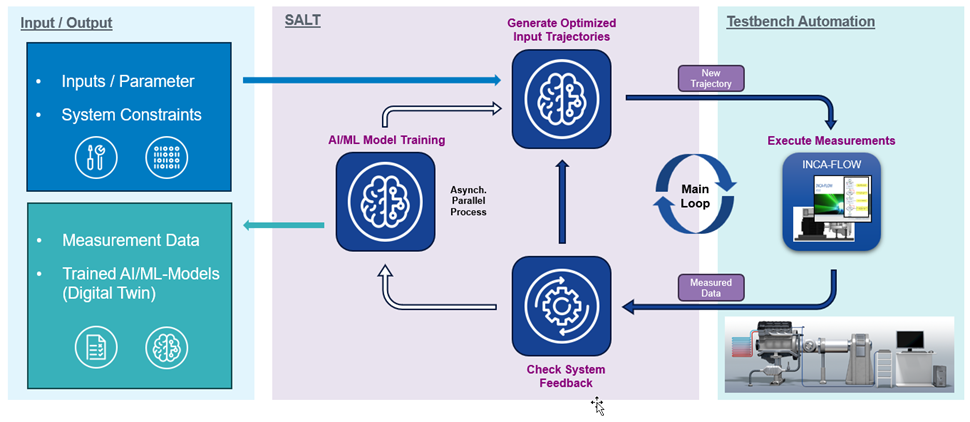
A SALT measurement campaign consists of three main stages:
-
System Description: The system under test is described by input variables, output variables, constraints, and a safe center point.
-
Iterative Measurement: SALT generates transient trajectories, evaluates them against the configured constraints, and updates the internal models with the acquired measurement data.
-
Result Generation: Finally, SALT generates trained models of the transient system behavior and a dynamic measurement plan containing the executed trajectories.
After the campaign is complete, the resulting trained models and dynamic measurement plan can be exported to tools like ASCMO-DYNAMIC and MOCA for further evaluation and visualization.