"Select a validation rule" Window

This window is opened with the Configure Validation Rule option in the Validation Rules menu of the ASCMO-Cycle Generator main window.

The Closed"Select a validation rule" window contains the following elements:
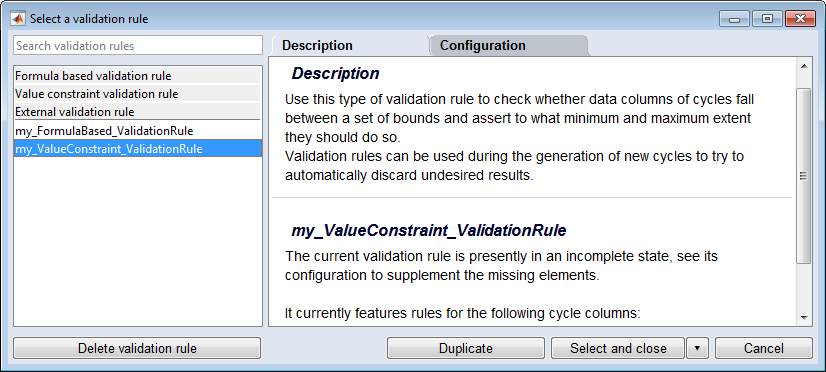
validation rules list

This list shows the validation rule templates (Formula based validation rule, Value constrained validation rule, and External Validation Rule) and the validation rules in your project.

Note  

The External Conversion RuleExternal Validation Rule template can be used only in the P-code version of ETAS ASCMO (ASCMO_SDK license).

You can filter the list by entering a search term in the "Search validation rules" field at the top of the list.

"Description" tab

This tab contains a description of the selected validation rule and its configuration.

Note  

Read the information in this tab carefully.

"Configuration" tab

This tab contains all properties that can be set for the selected validation rule.

Note  

You cannot edit the properties of the validation rule templates (Formula based validation rule, Value constrained validation rule, and External Validation Rule). Use the Duplicate button to create an empty copy of a template, then edit the copy.

The content of the tab depends on the type of the selected validation rule.
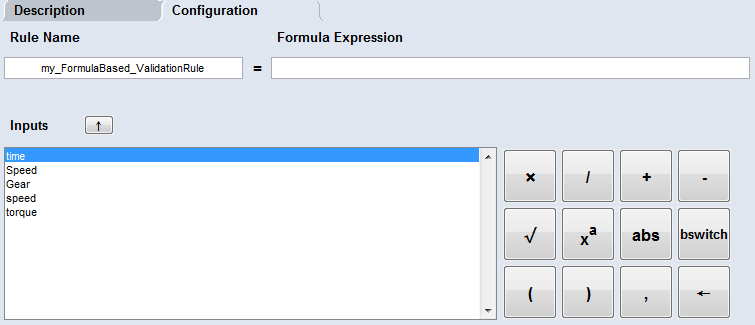
ClosedFormula based validation rule

  • "Rule Name" field

    Name of the validation rule.

  • "Formula Expression" field

    Expression or formula of the validation rule.

  • "Inputs" area

    The list shows all possible inputs. The button inserts the selected input into the formula expression.

  • button area

    Inserts the .* or ./ or + or - operator into the expression.

    This results in line-wise multiplication or division or addition or subtraction.

    Inserts the sqrt( operator into the expression. You have to add the closing bracket.

    Inserts the .^ operator into the expression.

    x.^y means line-by line yth power of x.

    Inserts the abs( operator into the expression. You have to add the closing bracket.

    Inserts the bswitch( operator into the expression. You have to add the closing bracket.

    See the button tooltip for a description.

    Inserts an opening or closing bracket into the expression.

    Inserts a comma into the expression.

    Backspace key for the expression field.

ClosedValue constrained validation rule

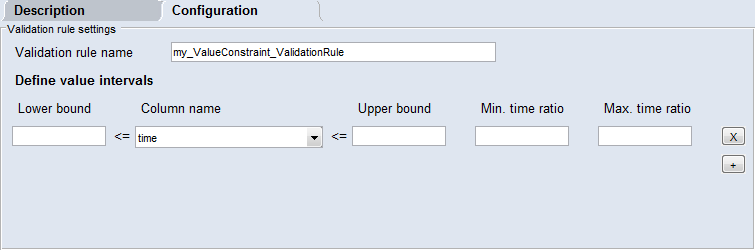
  • "Validation rule name" field

    Name of the validation rule.

  • "Lower bound" field

    Lower limit for the selected column. A value of -Inf means no lower limit.

  • "Column name" field

    The list shows all possible inputs.

  • "Upper bound" field

    Upper limit for the selected column. A value of Inf means no upper limit.

  • "Min. time ratio" and "Max. time ratio" field

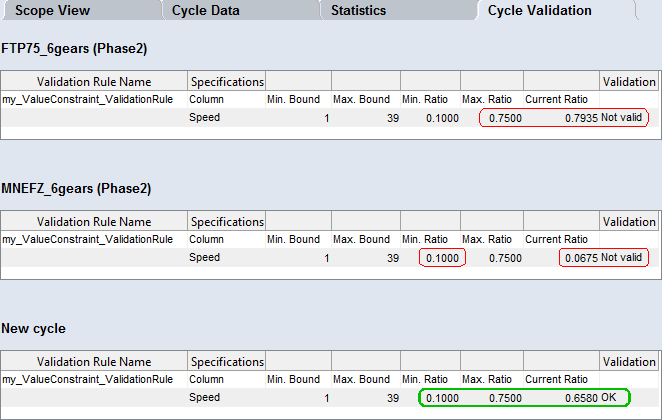
    Minimal and maximal cycle duration fraction during which the value in the selected column must lie within the bounds.

    If the column value is outside the bounds for more than "Max. time ratio" or less than "Min. time ratio", the cycle is considered invalid. See the Closedexample.

    The validation results are shown in the "Cycle Validation" tab of the main window.

  • button

    Deletes the respective constraint.

  • button

    Adds a new constraint.

ClosedExternal Validation Rule

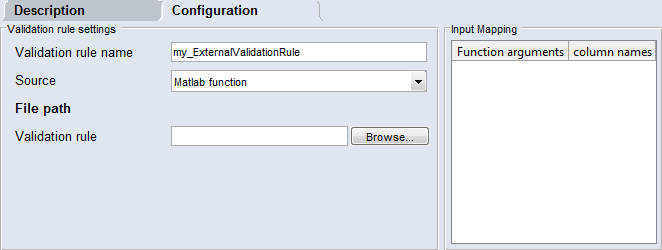
  • "Validation rule name" field

    Name of the validation rule.

  • "Source" combo box

    This combo box shows the available source types for external validation rules, e.g., MATLAB function.

  • "File path" area

    You can enter (in the "Validation rule" field) or select (via the Browse button) a file that contains the external validation rule. The allowed extension depends on the selection in the "Source" combo box.

  • "Input Selection" table

    The "Function arguments" column lists the arguments of the external validation function.

    In the "Column names" column, use the combo boxes to assign cycle columns to function arguments.

Delete validation rule

Deletes the selected validation rule. You can delete only one validation rule at a time.

Duplicate

Creates a copy of the selected validation rule or validation rule template.

The copy of a template is empty, the copy of an existing validation rule contains all settings of the original.

Select and close

This button selects the currently edited validation rule and closes the "Select a validation rule" window.

Cancel

Discards your settings and closes the window.

See also

Creating a Validation Rule