Resampling
Sometimes the measured data is sampled within too small a sampling time Ts (sampling frequency too high). A proper sampling time is about Ts £ T/10, where T is the system's dominant time constant. The down-sampled data set will also benefit the later modeling by reducing the training time. The resampling process is started with Data > Resampling.
The user only provides the resampling factor n, which means that the new time series is generated by picking every n-th data point out of the original series.
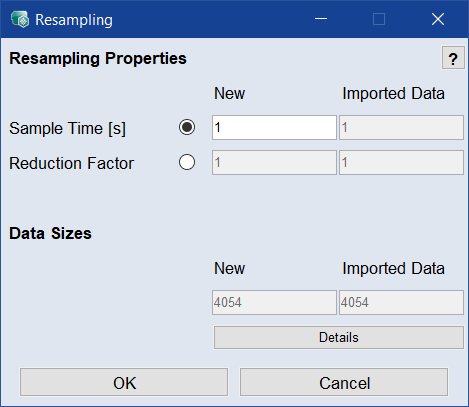
By setting the Sample Time, the absolute time difference in seconds between two samples of the signal can be defined. The Reduction Factor is a factor relative to the sampling rate of the original loaded signal (e.g., a reduction factor of 2 doubles the absolute time difference between two samples of the original data). Both settings lead to a resampling of the original data, which is possible based on linear interpolation.
The information fields concerning the data sizes show the number of samples using the current sampling rate as well as the original one.
The new and the original training data will be calculated and displayed automatically in the Resampling window.
|
Note |
|---|
|
For the diesel engine example, resampling is not necessary. |