Queued Communication
Elements in SenderReceiver interfaces can use queued communication. If set to queued, the semantics is that the corresponding element needs to be added to a queue (i.e., a FIFO data structure), from which it is later consumed by the actual receiver software-component.
Queued communication is activated in the AUTOSAR tab of the implementation editor of a SenderReceiver interface element:
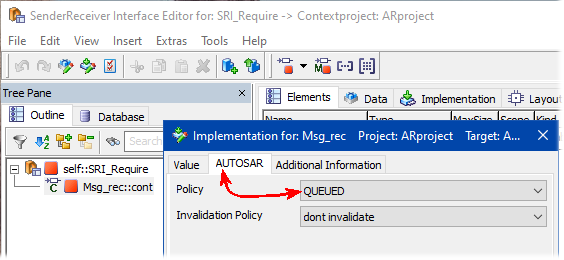
The following rules apply:
Queued elements must use explicit access.
If an implicit RTE Access operator is connected to a queued element, an error MMdl1132 is issued during code generation.
ASCET allows queued communication only for the elements of SenderReceiver interfaces.
If SW-IMPL-POLICY is set to QUEUED for an element of another interface, an error MMdl282 is issued during code generation.
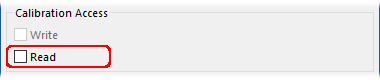
Calibration access to a queued element must be deactivated, i.e. SW-CALIBRATION-ACCESS must be set to NOT-ACCESSIBLE. In ASCET, this is done by deactivating both options in the
 Calibration Access area in the element's properties editor.
If SW-CALIBRATION-ACCESS is set to ReadOnly
, a warning WMdl283 is issued during code generation.The QUEUE-LENGTH of a queued element must be ≥ 1.
If it is not, an error MMdl2851 is issued during code generation.
Access to queued elements uses special RTE macros, see Rte_Send and Rte_Receive.
See also
Implementation Editor – AUTOSAR Tab (Scalar Elements)