Transformation Formulas
The following types of conversion formulas are supported: Identity, Linear, Moebius, Five Parameters. The display of the formula editor adjusts to reflect the formula type you choose.
The Identity formula represents an identity mapping.

The Linear formula represents a linear mapping with the coefficients c0 (offset) and c1 (gradient).

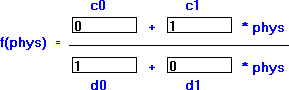
The Moebius formula represents a rational mapping as the quotient of two linear mappings, with the coefficients c0 (numerator offset), c1 (numerator gradient), d0 (denominator offset), and d1 (denominator gradient).
The Five Parameters formula also represents a rational mapping of the same kind in a different format with the coefficients p1, p2, p3, p4 and p56.
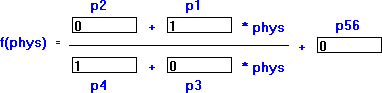
A reciprocal formula is a Moebius formula with c1 = d0 = 0 or a Five Parameters formula with p1 = p4 = p56 =0.
If one value is often used as the denominator of a division (e.g., a time period), the division can be reduced by calculating the reciprocal value once and then multiplying with the reciprocal value instead of dividing by the original value.
ASCET allows usage of non-linear formulas only the following cases:
non-linear formulas in general:
- an assignment if the left side and the right side use identical formulas
reciprocal formulas:
- division of a value with linear formula by a value with reciprocal formula
- division of two values with reciprocal formulas
- multiplication of a value with reciprocal formula and a value with linear formula (result has a linear formula)
- assignment of a value with reciprocal formula to a value with linear formula
- assignment of a value with linear formula to a value with reciprocal formula
- assignment of a literal value to a value with reciprocal formula
If all operands are literal values or values with identical reciprocal formula AND if the value ranges of all operands are strictly positive or strictly negative, the following operations can be used:
See also
Replacing a Formula Recursively