Characteristic Lines and Maps
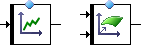 To support nonlinear control engineering, characteristic lines and maps are available in ASCET. They are used to describe a value in dependence of one or two other values, where either the functional dependence is not known exactly, or calculating the function would be computationally expensive.
For one table, the parameter and the output value must be of the same arithmetic type, e.g. there is no characteristic map where continuous and discrete types can be mixed.
A characteristic line is represented as a one-dimensional table of sample points, each of which is associated with a sample value. The sample points represent the x-axis of a function graph, the sample values represent the curve being described. The size of characteristic lines is limited to 65535 sample points.
Accordingly, a characteristic map is represented by a two-dimensional table of sample points for pairs of input values, where a sample value is associated with each pair of sample points. The size of characteristic maps is limited to max. 65535 sample points per axis, and the product of the axes sizes must not exceed the total size limit of 1.048.576.
If the max. size of an axis is < 1, or > 65535, an error MMdl771 is issued during code generation. If the total size limit of a characteristic line/map is exceeded, an error MMdl772 is issued during code generation.
Note |
|---|
You cannot edit the data of a characteristic line with more than 2048 sample points in the table editor. You cannot edit the data of a characteristic map with one or both axes larger than 63 sample points in the table editor. Instead, proceed as described in Editing Data of a Large Array or Matrix. |
Characteristic lines/maps are created as parameters. In block diagrams and C code components, they can only be read from within the model. In ESDL components, characteristic lines and maps are adaptive, i.e. additional methods are available that can be used to alter characteristic lines and maps.
If the monotony requirements set in the interpolation routine options or in the "Table Editors" node of the ASCET options window are not met when the table data are edited, a warning opens when the data editor for the table is closed. If you do not adapt the characteristic line/map to the monotony setting, a warning WMdl72 is issued during code generation.
Each characteristic line/map is associated an interpolation routine. This routine determines how the output value of a characteristic line/map is derived from the input value(s). With rounded interpolation, the value between two sample points is derived from the sample value at the lower (left) sample point. With linear interpolation, the value is derived from a straight line between the sample values. In addition to these interpolation routines provided by ASCET, user-defined interpolation routines can be used.
The interface of a characteristic line/map depends on its dimension and whether it is a normal, fixed or group characteristic line/map. There are basically three methods:
- void search (arithmetic type a): This method applies to normal characteristic lines/maps and to the distributions of group characteristic lines/maps. Here the correct supporting points are searched, and the interpolation factors are computed. For two-dimensional tables there are two parameters, i.e. void search (arithmetic type a, arithmetic type b).
- arithmetic type interpolate(): This method interpolates the value of the characteristic line or map from the interpolation factors and the value points at the associated supporting points.
- arithmetic type getAt (arithmetic type a) is the combination of the search and interpolate method. It is not available for group characteristic lines/maps. For two-dimensional tables, there are two parameters, i.e. void getAt (arithmetic type a, arithmetic type b).
The separation of the method getAt into the methods search and interpolate only makes sense for group tables/distributions. A distribution only has the method search. A group table only has the method interpolate. A regular or fixed characteristic table has all three methods.
See also
Group Characteristic Lines/Maps and Distributions
Fixed Characteristic Lines/Maps
Initialization of Composite Elements
Editing Data of a Large Array or Matrix
High-Resolution Interpolation Routines
User-Defined Interpolation Routines
Characteristic Lines and Maps in Block Diagrams