C Code Components
The specification of the body of methods and processes can be implemented in C code as well as in the form of block diagrams and ESDL. As with the other specification methods, only the body of a method or process has to be specified. The method declaration, the function head and frame, and the data instantiation and initialization are generated automatically.
In contrast to specifications in either ESDL or with block diagrams, components in C code are specified on the implementation level, rather than on the model level.
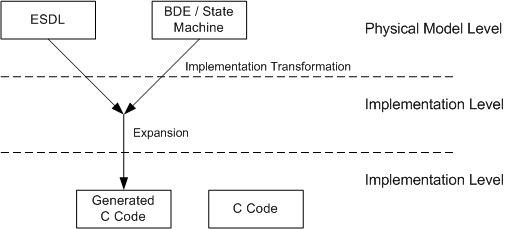
This has several important consequences:
- There is no transformation from the model to the implementation level.
- For each code variant (different target, different specification level, different implementations) the C code can be different. As a consequence, the code must be specified separately for each variant.
- The C code has to be adapted to the software architecture of the code generated by ASCET when user-defined types are used. This is because the interface is generated and the exact naming convention for the generated C functions depends on the expander and may not be transparent to the user. In the present expander, the identity tag of the class is used in the name for the generated functions in order to guarantee a unique name space.
See also